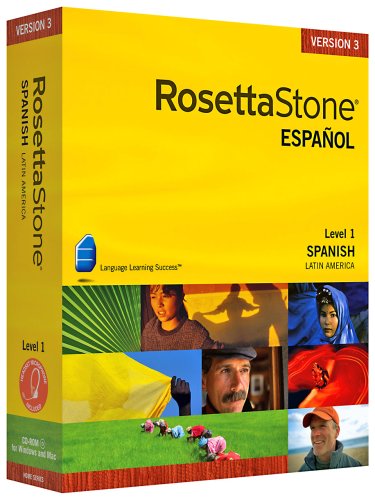
 Why is Rosetta Stone the world's No. 1 language-learning software? Because it works.
 Escape the endless tedium of translation, memorization, and grammar drills. Get the language you want, the skills you need and the success you deserve by learning a new language naturally--the same way you learned your first language.
 |  | |
 The complete immersion environment puts your native language-learning skills to work, eliminating your dependence on tedious translation and rote memorization. | | |
 |  |
| | |||
 Images Images |  |  Intuition Intuition | ||
| ||||
In Rosetta Stone you learn the meaning of new language from clear, real-life images.
In this activity you learn colors. | | You advance using language you've learned and clues from new images. That's your intuition at work.
Now that you know colors, you can easily grasp the meaning of the new words... | ||
| ||||
 Interactivity Interactivity | |  Instruction Instruction | ||
Throughout Rosetta Stone, you constantly interact with the program to confirm your intuition.
...and then check what you've learned. | | From beginning to end you build systematically toward your language-learning goals, for the most effective and enjoyable instruction anywhere.
And finally, you get the fun of trying your new language in a real-life simulation. Speech recognition shows you exactly how you're doing. | ||
| | |||


You learned your first language without translation.
You learned your first language easily and naturally by connecting words to objects and events around you. With Rosetta Stone, learn a new language the same way: using native speakers and thousands of real-life images to help you think in the new language from the very beginning. Studies show that learning exclusively in the new language, without translation as a crutch, is crucial.
The exclusive Dynamic Immersion method reinforces your natural language-learning skills with award-winning instructional technology. Identify your learning goals, then choose customized courses that take you there.
The timeless immersion method, along with research-based techniques and new technologies, make Rosetta Stone the clear solution to your language-learning needs.
What will you be able to do?
Understand everyday language.
Through Rosetta Stone's proficiency-based listening and reading activities, you'll learn quickly.
Pronounce words correctly.
After practicing with Rosetta Stone's speech recognition and analysis tools, pronunciation will come easily.
Speak without a script.
Contextual Formation makes sure you have the confidence and cues you need to get the words out on the spot.
Spell and write accurately.
You'll build gradually from letters to words and sentences.
Engage in real-life conversations.
With Milestone activities, gain confidence using speech alone in simulated situations.
Retain what you learn.
The unique Adaptive Recall reinforces language so it sticks with you in the real world.
Customer Review: Very Simple to Use
Rosetta Stone is very simple to use. However having a Spanish book, or obviously a native speaker to supplement the software would make it much more effective. This is because of being tossed directly into the language without a clear translation leaves the door open for some confusion. Overall a great interactive product that is a strong foundation to start learning a new langauge.
Customer Review: YOU NEED TO KNOW THIS
You cannot legally sell this software when you are done with it. They threatened to sue me when I did - they said I had not bought the software, but a license for the software and it was nontransferrable - that I did not have the right to even GIVE it away.
Many figure skating moves and techniques are based on ballet. Skaters who have a background in ballet should be able to transfer the positions and principles from ballet to skating. It is precisely this closeness to dance, and especially to ballet, that sets ice skating apart from any other sport. Although ballet and skating are similar, you have to think of them as two different worlds. There are many moves in skating that are similar to ballet, but you will have to break some ballet rules to get it right in skating.
The skater needs a strong core body to connect the upper and lower body for controlled powerful movements. He must be able to keep his shoulders over his hips throughout jumps, spins, footwork and edges. He must also be able to check his shoulders against his hips. Thus it is to the skater's benefit to become aware of the feeling of twisting in the middle of the torso, and also the feeling of staying square.
Figure skating and ballet require balance, strength in the legs, and ankle strength. They both use the same muscles, so ballet really helps figure skaters. Flexibility, balance, body alignment/posture, extension, and strength are just another reason to incorporate ballet to your figure skating. Many of the poses in skating are found in ballet, for instance arabesque, leaps, Rond de Jambe, Pli, etc. Ballet teaches the skater how to move the pelvis without losing balance or disconnecting the center in footwork sequences, including pirouette turns, jumps and leaps across the floor.
The entire foundation of ballet is poise and posture gained through core strength, making it the best way to learn how to present oneself and become graceful and elegant on the ice. Ballet helps with beauty and grace. Ballet dancers have a natural elegance in the way they carry themselves. The way their legs, back, arms, hands, feet, shoulders, and neck are aligned, always seems to have that flair grace. They have great posture.
Figure skating is ballet on ice. It can be one of the off ice training you implement to your skating for form and balance. Ballet uses body, mind and expression and while on the ice you have to express yourself as well. With ballet, you have a broader sense of how to perform, and to interpret and express your music as you tell your story or convey your emotion through the connecting steps of the program. This is what make the difference between a program that is all jumps with a lot of crossovers or stroking between the jumps, and a program that is interesting, artistic and pleasant to watch. Just as a dancer sweeps you away with her grace and flow and hides her/his sweat with a flourish, a skater will prepare you for a delicate show of artistry, acrobatic leaps and gentle arabesques.
The following is a brief summary of common terms and positions with which skaters should be familiar.
Rond de Jambe - A rotary movement of the leg.
It can be done in a number of ways, such as on the
floor with knee straight, or in air with a circular
rotation of the knee from bent to straight.
Pli - A bending of the knees with hips, legs, and
feet turned outward.
Arabesque - A position in which the dancer
stands on one leg with the other leg extended in a
straight line to the rear. The position of the arms
and the height of the raised leg may vary.
There are certain set positions in ballet for the
arms and particularly for the feet which give the
ballet dancer a particularly pleasing aspect as well
as providing a starting point for particular moves
and interchanges.
Skaters who have a background in ballet
should be able to transfer the positions and
principles from ballet to skating.
Foot Positions
There are five basic ballet foot positions that
are common to all teaching methods.
The feet point either in opposing directions either
in a straight line, or offset with one foot in front of
the other.
http://thetripleaxel.blogspot.com/
latin music lyrics
No comments:
Post a Comment