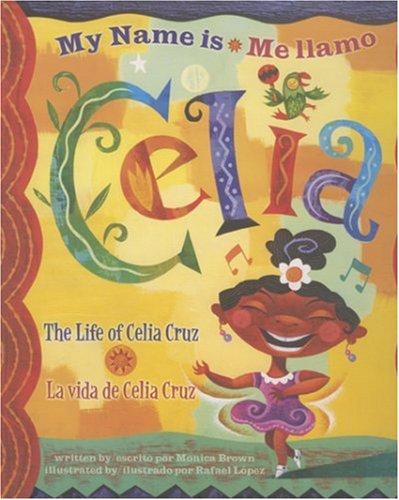
 This bilingual book allows young readers to enter Celia Cruz's life as she becomes a well-known singer in her homeland of Cuba, then moves to New York City and Miami where she and others create a new type of music called salsa.
Customer Review: Queen of Salsa
Celia Cruz is brought to life for young children in this colorful book. Like the tropics from which she came, the book is full of vibrant illustrations. The story is put into simple terms for young readers or a teacher or parent to read. Since the illustrations are so vibrant and bold children will be enthralled by the unique features of the art work. Each biographical page is bilingual for reading in Spanish or English or both. The book describes her early family life in Cuba, her departure after the revolution, her musical group Sonora Mantacera, meeting her musician husband,her associations with other salsa greats like Tito Puente and Willie Colon, her relocation to Miami and the various honors and recognitions she achieved. This is a great little book for primary and middle school libraries as well as community libraries. Students whoose first language is Spanish can benefit from the bilingual book through middle school years. This is a fun book.
Customer Review: Wonderful!
My Name is Celia: The Life of Celia Cruz is written by Monica Brown and illustrated by Rafael Lopez. The book is the recipient of a Pura Belpre' Illustrator Honor Award for outstanding work that portrays, affirms and celebrates the Latino cultural experience in an outstanding work of literature for children and youth. The exciting and inspirational life of beloved Cuban-born salsa queen, Celia Cruz, is celebrated in the bilingual book My Name is Celia Me Llamo Celia: The Life of Celia Cruz. Celia was born in Havana to a large family where their lives were intertwined and music was an important part of everyday life. Celia's papa wanted her to become a teacher but music filled her soul with happiness. She was encouraged by a teacher to "go out into the world and sing...." Celia experienced prejudice and fled her beloved country Cuba when the revolution began. From Cuba, Celia traveled the world sharing her love of music with the world. Rafael Lopez' illustrations are vibrant, fluid combinations of color that beg to be studied. The scenes fill the page and stir emotions as you read the story and live it through his drawings. Armchair Interviews says: My Name is Celia: The Life of Celia Cruz is a beautiful and educational addition to any child's library. We highly recommend it.
Cha-Cha music is 4/4 time, and also has 4 steps to a bar of music. The last bar screams for you to step to the left and close your feet so this step has the characteristics of moving the foot to the side and closing the feet, which in turn produces the "cha-cha" sound, which is the name of the dance.
If you are having trouble understanding the basic movement of Cha-Cha which is usually said to be slow, slow, quick-quick, slow, then rephrasing it to "rock, rock, side-close, side", makes it far easier to grasp.
Most Latino dances consist of moving your step on the second beat and change the weight from one lef to the other between beats, but in cha cha your feel always move only on the first, second and fourth beats of the music. This little switch of weight makes the look and feel of the dance occur on the first and second beats, then on the third and halway through the fourth and first beat.
Count from the second beat of music to make it simple. Count "Two-Three, Cha-Cha, One" - if you know the basic movements you'll soon see this becoming meaningful.
There are more than one part to timing, TWO. There is a static metronome beat that flows though the entire track, which in turn dictates when it's time to move your feet. Another one is the actual tempo of the song. The tempo is what makes you take a certain step, pause for a period of time or how fast you should spin and turn. Understanding this will make you a preferable cha cha dancer.
You can't mistake a Cha Cha beat in a song. You hear the two slow beats and the three quicker beats. Then when you hear the quick beats you move side and close, cha cha cha.
latin download
No comments:
Post a Comment